Is Gelatin Halal? Sources, Types & How to Check (2026)
Short answer: Gelatin is halal only if it comes from halal-slaughtered animals or fish. Most commercial gelatin in the USA is made from pork skins or cattle slaughtered without Islamic requirements — which makes it haram. Because gelatin rarely names its source on the label, the practical rule is: certified halal or fish gelatin only.
What Is Gelatin — and Why Is It Everywhere?
Gelatin is a protein extracted by boiling animal bones, skin, and connective tissue. The extraction process breaks collagen down into a tasteless, odorless substance that gels, thickens, and stabilizes — which is why manufacturers love it. It shows up in three big categories:
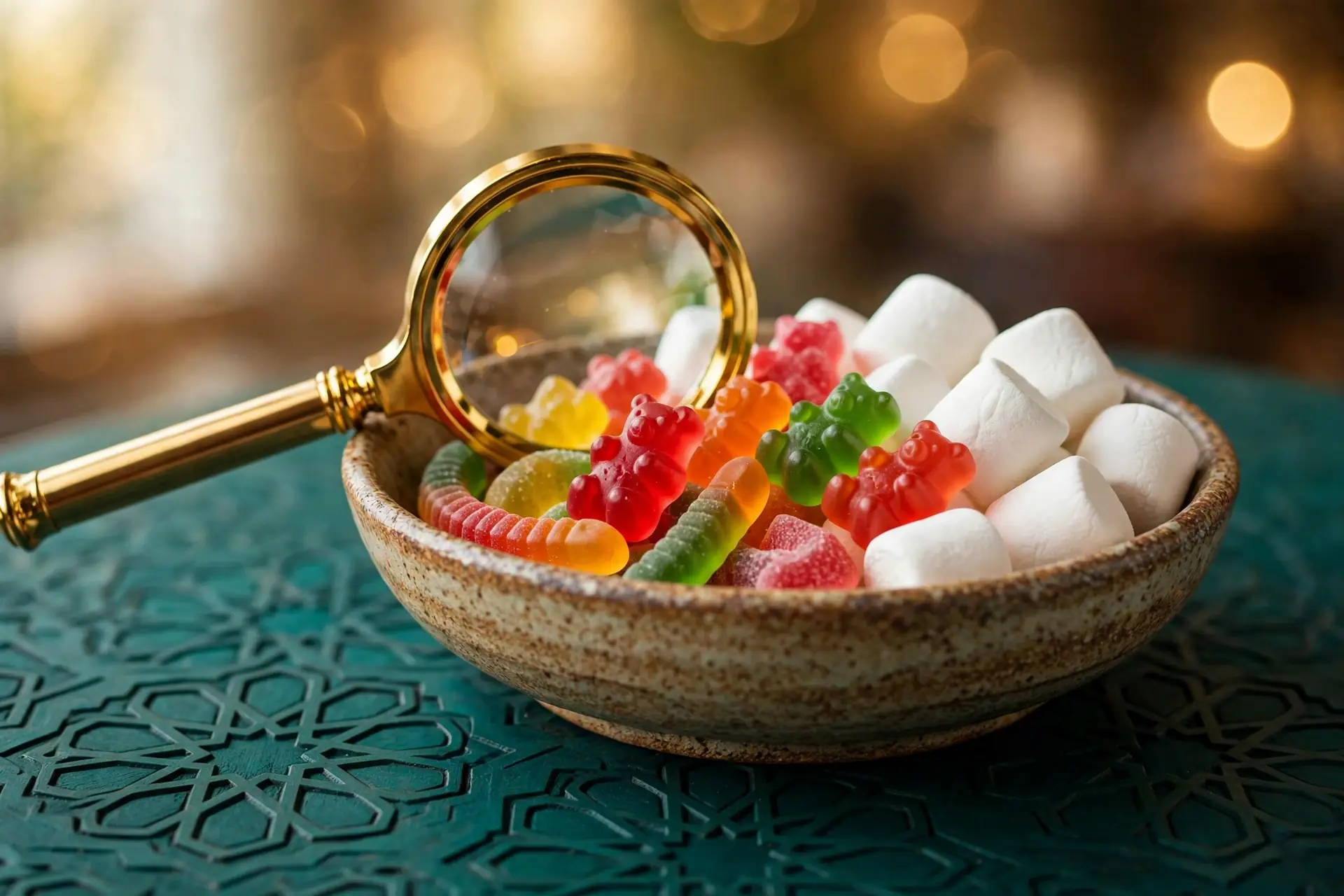
- Food: marshmallows, gummy candies, Jell-O and jelly desserts, yogurt, frosted cereals, some ice creams, cheesecakes, and mousses.
- Pharmaceuticals: the shells of hard and soft gel capsules, coated tablets, and suppositories.
- Cosmetics and toiletries: some shampoos, face masks, and creams.
The problem for Muslim consumers: gelatin is functionally invisible. A gummy bear doesn’t taste like meat, and the ingredient list usually just says “gelatin” — with no word about which animal it came from. That makes it one of the most common hidden haram ingredients in the modern food supply.
The Three Sources (and Their Rulings)
| Source | Ruling |
|---|---|
| Pork gelatin (pig skins/bones) | Haram — pigs are categorically prohibited in the Quran (2:173, 5:3, 6:145, 16:115) |
| Bovine gelatin from non-halal slaughter | Haram per the majority of scholars — meat of an animal not slaughtered Islamically is impermissible, and its derivatives follow the same ruling |
| Bovine gelatin from halal-slaughtered cattle | Halal — provided the slaughter met Islamic requirements and this is verifiable (certification) |
| Fish gelatin | Halal — fish is exempt from ritual slaughter requirements |
| Plant-based alternatives (agar-agar, pectin, carrageenan) | Halal — no animal source involved |
In the United States, the overwhelming majority of commercial gelatin is Type A (acid-processed, usually pork skins) or Type B (alkaline-processed, usually cattle bones/hides). Pork-skin gelatin dominates because pig skins are cheap and abundant. Cattle-derived gelatin in the US supply chain comes from conventional slaughterhouses, not halal ones — so “bovine gelatin” on an American label is, by default, doubtful at best.
Why the Source Matters: The Fiqh Behind It
The ruling on gelatin follows the ruling on its source animal. This is the application of a simple principle: a derivative (far’) takes the ruling of its origin (asl) unless a valid transformative process changes it. Pork is haram in itself, so pork gelatin is haram. An animal that died without Islamic slaughter (maytah) is haram, so gelatin extracted from it is haram per the majority.
This is why “it’s just a tiny processed ingredient” doesn’t settle the question — the source is the starting point of the analysis, not the end of it.
The Istihalah Debate — Honestly Presented
There is a genuine scholarly discussion here, and it deserves an honest summary. Istihalah (chemical transformation) is the principle that when a substance changes completely into something else — new properties, new name, new nature — its ruling can change. The classic example: wine turning into vinegar.
The minority position: Some contemporary scholars argue that the intense chemical processing gelatin undergoes (acid/alkaline treatment, prolonged boiling, filtration) transforms it so completely that the original source no longer matters — making even pork-derived gelatin permissible. They point to the vinegar precedent.
The majority position: Most scholars — across the Hanafi, Maliki, Shafi’i, and Hanbali schools — hold that gelatin production does not constitute the kind of complete transformation the vinegar example describes. The protein structure remains animal protein; the change is physical processing, not a change of essence. Therefore gelatin from a haram source remains haram.
The practical conclusion: Given that the majority position is also the cautious one, the safe course is clear — require halal-certified or fish gelatin, and avoid doubtful sources. This is the position this article recommends.
Halal Certification: What Actually to Look For
Because the source is invisible, certification is the only reliable shortcut. On US products, look for:
- Recognized halal logos: IFANCA, Islamic Services of America (ISA), Halal Monitoring Committee (HMC), or other established certifiers. A real logo with a certification number beats a vague “halal” claim in the marketing text.
- Explicit “halal gelatin” or “fish gelatin” in the ingredient list — some manufacturers now state the source voluntarily.
- Vegan/vegetarian labels as a secondary signal — a product labeled vegan cannot contain animal gelatin (though always double-check, since labeling errors happen).
Be cautious of products that say “suitable for halal diets” without any certifier name — that phrase is unregulated marketing, not verification.
How to Check Labels: A Practical Method
- Find the ingredient list — gelatin appears as “gelatin,” “gelatine,” or E441.
- Look for the source qualifier. “Porcine gelatin” or “pork gelatin” = haram, clear-cut. “Bovine gelatin” or “beef gelatin” = only acceptable with halal certification. “Fish gelatin” = halal. “Halal gelatin” = halal.
- No source given? Treat it as doubtful and avoid. In the US market, unqualified “gelatin” is pork-derived more often than not.
- Check for a certifier logo — the fastest reliable check.
- When in doubt, contact the manufacturer. Most major brands answer source questions; ask specifically “is your gelatin porcine, bovine, or fish-derived?”
For a worked example of reading a real product label step by step, see our Doritos breakdown.
Gelatin in Medicine: The Necessity Exception
This deserves separate treatment because the stakes are different. Gel capsules are the delivery mechanism for countless medicines, and halal-certified alternatives don’t always exist.
The principle of darurah (necessity) applies: when a needed medicine has no halal alternative, scholars permit the otherwise-haram capsule. The conditions, as generally understood:
- The medicine is genuinely needed (not merely preferred or cosmetic).
- No halal or gelatin-free alternative is available — check with your pharmacist; many drugs come in tablet, liquid, or vegetarian-capsule forms.
- Use is limited to the need.
Practical steps: ask your pharmacist whether the same drug exists as a tablet or liquid; look for “vegetarian capsules” (HPMC) versions, which many supplements now offer; and discuss your specific situation with a qualified scholar, since necessity is judged case by case.
Gelatin in Cosmetics
A brief note: scholars generally treat external-use products more leniently than things consumed. Most hold that impure substances in cosmetics that are washed off do not affect worship, though some prefer avoidance. This article focuses on consumption, which is where the strict ruling applies.
Halal Alternatives Worth Knowing
- Agar-agar — from seaweed; the closest 1:1 substitute for gelatin in desserts. Available in most US grocery stores (often in the Asian foods aisle).
- Pectin — fruit-derived; what makes jam set. Many “vegan gummies” use it.
- Carrageenan — seaweed-derived thickener.
- Fish gelatin — behaves almost identically to bovine gelatin; increasingly used by halal-certified manufacturers.
- Halal-certified brands — a growing number of US companies now sell halal-certified marshmallows, gummy candies, and jelly desserts explicitly. Look for the certification, not just the word “halal” in the brand name.
FAQs
Is beef gelatin halal?
Only if the cattle were slaughtered according to Islamic requirements — which must be verifiable, normally through certification. Ordinary “beef gelatin” on a US label, without certification, is doubtful and best avoided.
What about gelatin in medicine?
If no halal or gelatin-free alternative exists and the medicine is genuinely needed, the principle of necessity (darurah) permits it. Check with your pharmacist for tablet, liquid, or vegetarian-capsule versions first, and consult a scholar about your specific case.
Is Jell-O halal?
Standard Jell-O sold in the USA is not halal-certified, and its gelatin source is not disclosed as halal. Choose halal-certified jelly desserts instead.
Does the istihalah argument make pork gelatin permissible?
A minority of contemporary scholars say yes; the majority across all four schools say no. The safe and recommended position is to require halal-certified or fish gelatin.
Is fish gelatin really halal without certification?
Yes — fish is exempt from slaughter requirements, so fish-derived gelatin is halal by source. Certification still helps confirm the product wasn’t cross-contaminated, but the source ruling itself is clear.
What should I do with products I already bought?
If you discover a product contains haram gelatin, stop consuming it. What passed unknowingly is a matter between you and Allah — the obligation is to correct course going forward, not to punish yourself for the past.
Disclaimer: Educational purposes only — not a fatwa. Formulations change; verify labels.
About the author: Zakariya Shafi — Dars-e-Nizami (Wifaq-ul-Madaris), M.Phil Islamic Studies (BZU Multan), 15 years teaching Islamic studies.